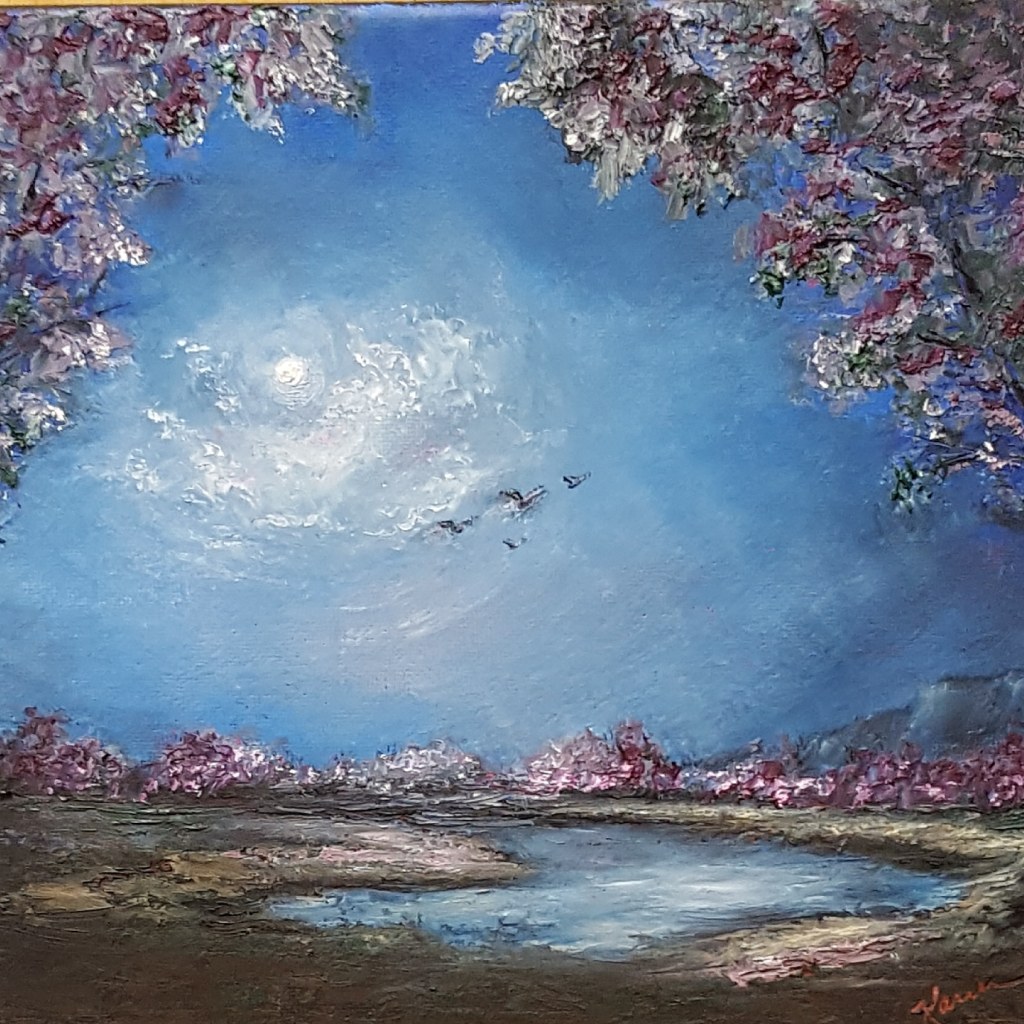
The second painting in The Magic of the Moon series (I guess it’s a series… or not) took me back to the mediums and technique I most love. Oils, cold wax, and palette knives.
Moon Flight is a painting purely from the imagination. All I knew for sure was that I wanted a moon, clouds, and water. As it evolved, I let the perceived magic of the moon illuminate the land, the sky, and bathe the water with bright light. The birds were added when I realized there should be more to this story. It wasn’t just about the moon. There needed to be a second subject. Birds. Birds on their way to a secure place to settle down for the night. Nature in harmony. I lowered the sky and added the limbs in the foreground.
Now my moon had a purpose other than just reflecting light to a sleeping landscape. It was the nightlight in the sky providing a safer passage to the creatures of the day as they made their way through the dark.
I really enjoyed painting this one and love that it found a home with a couple who enjoyed it as well. They also saw and felt what I did while creating it. The magic of the moon is more than just visual. There is purpose as well.
Doesn’t have to be at night either. Even daytime sightings have an effect on me. Maybe it all goes back to childhood when stories and imagination made such an impact on me. Or maybe I am just a child of the moon. More drawn to this magical orb in the sky than I am to the sun in it’s various appearances. Maybe that’s why I often feel the need to add a moon to many of my landscapes… even if it is just a hint of one off in the distance when it hasn’t made it’s full exit or full entrance to the sky. The magic of the moon is real to me. Ok, let’s just say it’s very appealing. (I wouldn’t want you to think I dance around half naked at night waving and chanting. However, if that is something YOU do, I’m not judging.)
Science tells us that the moon does indeed have an effect on our natural world, including us. History tells us it has indeed been a subject of awe and adoration to many cultures. But this missive is not about science or history, this is about painting and trying to capture the magic of that reflective rock in the sky. The magic of the moon.
In the painting Moon Surf, I was remembering the many nights from various vacations on the Alabama and Florida coast. Nights with the moon shining down on the water, the soft glow of drifting clouds embracing the moonlight, and the glorious soothing sounds of the waves coming on shore. Maybe for you, it brings back a memory from another place, a different setting.
Unlike the majority of my landscapes/seascapes, this one was done using acrylics (gasp!) and brushes (double gasp!). If you don’t know, I prefer to use palette knives and now I mostly use oil paint. I rarely take a painting done with brushes and acrylic to the gallery.
When I hear the word “garden” I think of an area that was put in with a lot of thought. Something planned. Neat sections of either veggies or flowers, shrubs, etc. Areas that people admire and might say “Wow, that’s impressive!”
Not mine.
My garden areas are planned, but what’s actually planted in them are a bit haphazard. They need some work (always) and I wouldn’t use the words “neat” or “wow” in any description of them. No, someone would most likely say something more like, “Oh, how… nice. Must be a lot of work.” Which really means: “You don’t spend a lot of time weeding, do you?”
I put plants in flower beds with the hope that they live and look somewhat attractive. Attractive to me. Attractive to the birds and butterflies. As they get out of hand, I try to wrangle them in… the beds, not the birds and butterflies.
My flower beds are often the result of experiments in what will or won’t grow in a particular spot. They won’t attract any local Garden Club visitors or awards. However, no matter what the areas look like, I will have visitors that appreciate my efforts… visitors in the form of squirrels, rabbits, and the aforementioned birds and butterflies. (Other insects will not be talked about. I have declared them, especially those that bite, insecta non gratis.)
The birds enjoy plantings they can hide or nest in. The rabbits enjoy just about anything they can eat. I have had to say goodbye to many a colorful flower due to them being a tasty treat for the bunnies. (That’s ok. I like watching bunnies and have had several over the years who trust me enough to let me get close.) The squirrels enjoy digging in the flower beds and taking the occasional nibble at the roots of some of the plants. Then there are the butterflies who seem to enjoy everything.
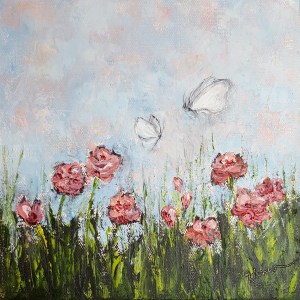
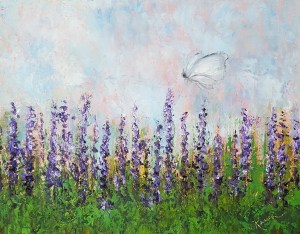
Sadly, the many varieties that used to come have diminished over the years. However, the little white ones still love to hang around and keep returning summer after summer. I’m no expert, but they look like ones called “southern white”. These little visitors to my garden are quite active. They dance from flower to flower, and plant to plant, as they seem to explore and delight in what is out there.
Due to their continued presence and apparent delight in my yard, I included them in a series of paintings for an art show I had in June. It was my way of saying, thank you little butterflies, I appreciate you and you can be visitors to my garden any time you want.
As I mentioned in an earlier post, I never hit the golf course early in the morning. Teeing off to the sun coming up was not for me. However, playing late in the day is something I always enjoyed (except for the mosquitoes). Being on a course early and late evenings appealed to me. Especially when there was enough clouds and other particulates (great word, rolls right off the tongue) in the sky to make for a gorgeous prelude to sunset.
I often paint sunsets, I just love seeing them, and sometimes will paint them with a golf theme. This is my latest one and comes from many memories of being on the last fairway or last few fairways heading back to the clubhouse. It’s a soothing time of day. Yes, the shadows and loss of light did make it hard to see where the ball landed. But let’s be honest, we seem to have that problem even during the brightest time of the day. “Did you see where it landed? What do you mean, you weren’t watching?” Yeah, yeah.
Evenings often bring out sounds and sights you wouldn’t see during the mid-morning to mid-afternoon times. Families of deer nibbling grass on the fairways. Rabbits and (depending on where you are) foxes, coyotes, racoons. Birds are settling down for the night and singing their end of day songs. Stars are starting to light up in the darker areas of the sky. Colors are less washed out.
Even if you weren’t having your best day on the course, something about that last fairway when the sun is getting ready for bed makes it a little bit better. At least it did for me. Hopefully, for you too.
If you’ve been reading any of my latest posts, you will know that I used to play golf. Wasn’t great, wasn’t terrible, but loved playing. At the time I was a member of the Executive Ladies Golf Association and our local chapter played a lot all over Louisiana, Mississippi, Alabama and Florida. We also played in some regionals in other states to the north. Anyway, recently, for some reason, I’ve been thinking about those days.
Today’s topic? Birdies.
Birdies, for me did happen once in a while, but they were not the norm on my scorecard. However, because of where I played, I got to enjoy many birdies of the avian variety. Birds and golf courses. They go hand in hand.
One time when I was working as a volunteer for the PGA Tour when it was at English Turn in New Orleans, the foursome teeing off had to wait while a male duck chased a female duck all over the front area of the tee box. Both were quacking like crazy and everyone was laughing their heads off. Took several minutes for the crazed courtship to careen down to the wooded area next to us. The starter had some funny things to say which only prolonged the laughter and the delay.
All kinds of feathered friends live at golf courses. Ducks, geese, wild turkeys, and I kid you not… peacocks. Yes indeed! Imagine getting ready to hit your ball and a peacock lets loose with a scream. One of my foursome almost let go of her club on that swing. I believe that was on a course somewhere near Lumberton, Mississippi. Really pretty course. Have no idea if it’s still open and now wonder if the peacocks are still around.
I have to say, of all the birds found on courses, I do believe that I enjoy seeing herons the most. All kinds and sizes have patiently watched me play by. They are so stately and quite elegant when they take flight. Watching one always seemed to have a calming effect on me.
At least until I sliced my shot. Oh well. I’ll just paint them now.
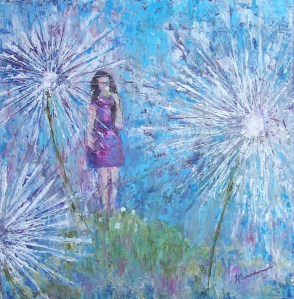
One of the many things from my childhood that makes me smile are the memories of picking dandelions that had gone to seed. What a joy it was to pick them, blow, and make wishes in the wind.
Seems easy, but there was a learning curve to it. Blow too hard and the fluffy head of seeds exploded. Blow just right, with pursed lips, and the seeds gently lifted into the air and rose higher and higher with the currents. Blow into the wind and you wound up with seeds in your hair, your mouth, your nose. Not fun.
Making your wish prior to sending them airborne was the ultimate thrill. You just never knew if a seed would carry that wish to the right “unknown” whereby the wish would be granted.
Many a race was run as I would try to be the first to get to a ripe dandelion before friends got there. And many a near fight would take place when, before I could make that wish-filled blow, someone next to me would blow first! Little heathens. There are unwritten rules for making dandelion wishes.
I still enjoy watching a child following the ages old tradition of picking one of these magical weeds and making a wish prior to blowing it into the air. Sharing that moment with a child is even better. The younger they are, the more magical the moment is.
However, if the magical, wish inducing, dandelion being blown into the air was found in my yard… then I really hope the wind is blowing away from my lawn.
I think that I shall never see, A painting tool so right for me.
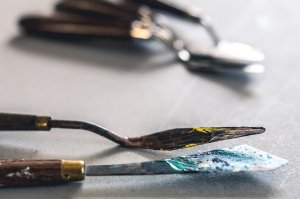
Though people often use the term palette knife when referring to any type of metal blade used for painting, there is a difference between a true palette knife and a painting knife (yep, I got that right off the internet). However, I’ll let you do the research if you’re interested. It’s really not that important. They can all be used to paint with (even the cheap plastic ones, if you’re on a budget).
The Love Affair Begins
Less than a year ago, I rarely used palette knives. I was mainly a brush painter. Then I met cold wax. Cold wax set me up with palette knives. At first we just played around and watched a lot of videos. I had no idea how strong the attraction would be. I just couldn’t stay away. I had to know more. I had to be with them… use them.
Now, palette knives are now my first choice when making art and are perfect for my preferred method/style of painting (whether using oils or acrylics). It’s fascinating to see what can be done with palette knives and different mediums. The layering, the scraping, the marks they can make. It’s quite exciting. I LOVE my palette knives.
Other reasons I love them are: they are not expensive, versatile, can take a lot of abuse, and are easy to clean. You can paint big and bold, or small and precise. (It just takes practice.) They aren’t limited to the traditional oils and acrylics either. I’ve seen them used by a watercolor artist. Yes, watercolors. Who knew? Someone experimented and it worked.
Where Did they Come From?
I’ve often wondered how this painting tool came into existence. I mean, did someone notice a bricklayer with a trowel and think “hey, I can slap a LOT of paint on a canvas with one of those!”
I don’t know.
I do know that palette knives can be traced back to the 17th century and were most likely first used to mix paint on the… tadaa.. palette. (Bet you saw that coming!) They were also used to scrape paint off of the canvas. (Made a mess? Using Oils? Still wet? Scrape it off!) By the 18th century, the palette knife was a popular tool with artists and they were widely used. Somewhere along the way, this handy dandy tool went from being a tool used just to mix or scrape off paint to being refined into a tool of many shapes and sizes for creating a painting. Just like brushes.
Want a Storage Tip?
My knives.
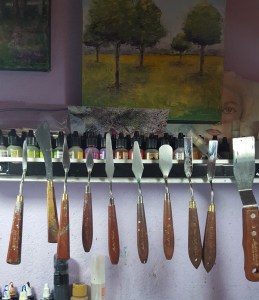
Go to someplace like Lowe’s, Home Depot, or Harbor Freight and look for a magnetic strip used for holding small tools. Attach it within reach of your painting area. The metal blades of the palette knives will attach to the strip. Gets them up and out of the way, yet keeps them close for when you need one.
This is the year I decided to step up and invest in myself. To put myself out there. To get my artwork in front of the public. And, sometimes, this requires spending some money. Investments are rarely cost free.
It wasn’t an easy decision. I had been full of doubts about whether or not I was “there yet”. When the opportunity first presented itself this past summer to become a part of the local art gallery (which had become a co-op of local artists) I let the doubts creep in and I passed it up. I spent the next six months kicking myself.
My Step One: Ignore the Doubts and Jump In
So… when I found out last November that they were still taking artist applications to join, I didn’t hesitate. No more kicking myself. I presented my work, made it in, and signed a six month financial commitment. Was it scary? You bet! Let me repeat… it was a financial commitment. What if nothing sold? I’m in a gallery with over 40 other artists/artisans and with people who are well known around North Texas. Boy was I nervous.
I also felt very vulnerable. When you put yourself out there, no matter what your creative thing is, you get viewed (and critiqued) by others. Others who usually have no clue about the process, the practice, the techniques, or the cost of what goes into what you have created. They only know what they like. Unless, of course, they too are an artist because artists know.
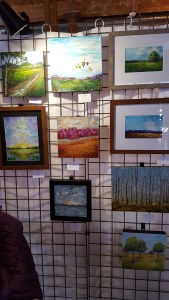
So… I hung my first artworks in December at the gallery. Has it been worth the monthly fee to have space there? YES! My work is selling and I do a happy dance for every one of them. I take nothing for granted.
My Step Two: More Public Interaction (Getting to Know Me)
I just took part in the indoor Winter Art Fest here locally. Step number 2 of putting myself out there. Participate in more public events. (Of course now, depending on how that darn virus spreads, that may take a backseat for a time.) Relationships are important and I need to cultivate them! Anyway, I don’t have to get into all events, just those that work for me, my schedule, and my pocketbook. As a lot of you know, there are lots of events that don’t involve any financial commitment to participate but are a great way to get your name and work out there. I’ve got several in mind for where I live.
Winter Artfest
My Step Three: Invest in Simple Advertising
I have started giving out business cards instead of leaving them in my purse. (If you prefer, you can just call them introduction cards.) They are the cheapest way to advertise what you do. If you are on Facebook (or Instagram) and have a page for your artwork or other creative outlet, it won’t break the bank to make a post and then boost it for a week to an audience that meets YOUR criteria. Social media is a great way to promote what you do. However, I’m a little concerned about Pinterest. Seems a lot of people find their artwork getting swiped from there and showing up where it shouldn’t. Anyway, I know it’s a slow process to get noticed and I don’t expect instant success.
My Step Four: I Don’t Have One
The steps above should suffice for now. I believe in myself and I’ve worked hard to get where I am in my art journey. I love what I’m doing. I am now investing in myself so others might love what I’m doing and invest in me as well.
Now, if you’re ready, go out and invest! Invest in yourself!
When I was younger, I loved hiking. I actually still do, though my stamina is really crappy now. Anyway…. not the serious gotta have a backpack, camping gear, GPS, bear repellant, etc. kind of hiking. I’m talking about the kind where you just go out and follow a path or two through a state park, local park, or the woods behind your house. There’s something freeing about venturing forth, water in hand, to just explore where the path leads you.
Life is full of paths too.
Following Your Path: Have a Plan
Here’s the thing with me and maybe with you too. I don’t blindly forge ahead. I make sure that the path I want to take is doable. I don’t want to get lost or hurt following it. So I plan… usually. Yes, it’s exciting to step off the path and see “what’s over there”, as long as you keep a firm eye on where you were, so you can get back on it. Lost is not a fun thing to be.
Following Your Path: Keep Moving
Your career, your hobby, your art, your hike in the woods should never be stagnant. Not moving gets you nowhere. Enjoy the stops to rest, explore, enjoy the view…. but keep moving forward. When I look at my artwork from years ago to where I am now, I see all the paths I took to get here. And I see how I kept moving forward. Occasionally, I see where I got off the path, but I managed to get back on it. I didn’t give up getting to where I wanted to go and I’m still exploring as I journey on.
So… follow your path, plan for new ones, take a break if needed, but keep moving.
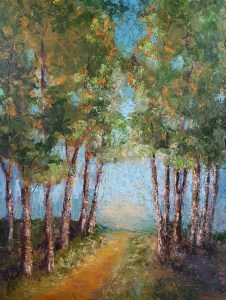
I love trees. I find myself including them more and more in my paintings, which is a real change for me because I never felt good at doing so in the past. However, you know what they say about practice. Thousands of people regularly paint trees so obviously there’s a lot of practice going on. Painting trees is hugely popular with artists. So many interpretations! Trees are also a popular subject with poets and other writers.
Advice From A Tree
Stand tall and proud. Sink your roots into the earth. Be content with your natural beauty. Go out on a limb. Drink plenty of water. Remember your roots. Enjoy the view. – Ilan Shamir
The Tree Amigos: It Didn’t Start This Way!
When I started this one, I had no intention of painting trees. It actually began with the idea of a rainy day and a child under an umbrella. That’s all. No trees. Just a little girl ( which became two) under a large umbrella. And that’s what I did! I had mixes of blues, violets, grays, whites on my palette and with my palette knives, laid on my background then when dry enough, added the figures. However, the composition bothered me. Therefore, I swiped through it all, removed a lot of the paint, and in the chaos of colors I saw a street scene. I worked that idea for a while, but didn’t like that either. It just didn’t speak to me. Actually it did speak to me… it said “noooooo”. So I scraped and wiped and re-swiped the colors and sat back and just looked at it for several minutes. That’s when I started seeing trees in the shapes. Trees and water and sky. So I started developing the shapes and moving colors around. In the end, I had a painting of three trees which I finally named The Tree Amigos.
Speaking of Trees
If you google it, you’ll find that there are over 60,000 tree species in the world. The ten most common in the U.S. are the Red Maple, the Loblolly Pine, Sweetgum, Douglas Fir, Quaker Aspen, Sugar Maple, Balsam Fir, Flowering Dogwood, Lodgepole Pine, and the White Oak.
A lot of lovely subjects if you like painting trees. I guess I had better get to practicing.






 KARREN CASE ART